
Wednesday, January 18, 2012

Tuesday, November 22, 2011
Monday, October 3, 2011
Day after: some musings
Performance art, like music and dance, is distinguished by its lack of an art object. Unlike painters and sculptures, once the performance art event is complete there remains no trace of it, except in the memory of those who were there to witness the performance.
Artists like Vassan Sittiket and The Turner Prize use accessories during their work. But the viewing of a piece of broken glass from Arti Grabowski’s (or Pancho Lopez’s) performance is not the same as the viewing of a painting or a sculpture. The shard of glass is a trace, a souvenir that links us back to the art event. It is not an art object in itself.
The shard of glass or the grain of rice is incomplete and static. Outside the moment and context of the performance, as our memory of the art event fades, the small power of these objects also fades. Soon they fall back into the wash of the day-to-day.
So where is the art in performance art?
As I am sure you have noticed, the photos of Hua (Phoebe) Jin the photographer for the festival and the videos of Elisha Burrows the videographer are particularly strong. Both do beautiful work. This is important because their documentation of the Live events is often all that remains after the show.
Over the course of the festival, I saw that the photos, the video and the brief descriptions of performances in the blog had a powerful transformative effect upon many of the performances, changing sometimes difficult viewing experiences into something more intense, more beautiful and easy to consume. Take for example Anna Syczewska’s piece, the hour-long arc-welding session.
For the live audience in the gallery at Vivo, the piece was long and physically grueling. After we had seen the first spike welded to her shoe, was it necessary to stay and watch the process for the next nine? The blinding light, the fumes and the music pushed most people out of the gallery to the bar and onto the street.
During that hour however, Phoebe and Burrows captured moments with striking effects and stunning beauty. For someone who was not in attendance, looking at the photos and the edited video, reading the few lines of text describing the action, their reaction might be “Wow! That looks incredible” or, “ Sorry I missed that show”.
Watching performance art is a bit like hiking up a high tree-covered mountain. For hours and hours the hiker climbs up the trail under a thick canopy of trees seeing nothing more than the rock-strewn path. Sweating under the heavy load of a pack, scrambling and stumbling, plagued by mosquitoes and deer flies, the hiker dreams of the end of the climb, imagining the crest of the mountain is just up ahead around the next switchback. When at last the hiker reaches the crest and looks out at the surrounding countryside spread out beneath, the view is magnificent. But after a few minutes rest, eating an energy bar and enjoying the splendor, it is time to climb down through the dense forest again.
The photographer, the video editor and the writer of these events create an abstraction of the performance, reducing an hour of difficult exertion into a couple moments of pleasure. In this reduced concentrated and form we can consume the experience, shooting it back like our morning de-caffe latté with soy.
Sometimes in moments of exhaustion, one asks oneself whether or not a postcard of the gorgeous view from the top of the mountain would be just as fine and aesthetically fulfilling as the hours long slog needed to climb to the viewpoint.
The problem with this shortcut is that the art in performance art takes place at a particular moment, in a particular place. The art is the phenomenon that takes place as the viewer witnesses the performance. The performer’s actions elicit a set of thoughts, emotions, and sensations in the viewer, a communication. If you are not physically there to witness and experience that communication, it’s a bit like getting a post card from Mazatlan in the middle of February.
“Having a wonderful time. Wish you were here.”
It is just not the same as two weeks lying on white sand under a blazing sun.
FA
Vive la Live Biennale - Masashi Ogura
Click on the image to enlarge it.

La Live Biennale 2011 avait un pas mal de succès comme show-case des performances actuelles. La variété était évidente depuis l'acte archaïque ou émouvant jusqu'au high-entertainment pour le public de Vancouver. Parmi les performateurs, Nobuo Kubota a montré que l'art de performance est faisable sur une chaise seule et sans un grand décor (la tradition japonaise?). Vive la Live Biennale 2011!
Thursday, September 29, 2011
Day before the end
My friend Robbie works in a Pediatric clinic, where he sees the gamut of disease and accident that come though the clinic door. There are cases of morbid congenital syndromes and homicidal neglect. It is a difficult job, seeing children die, telling the parents of their child’s illness, working with the Child Welfare Services.
Robbie accompanied me to Saturday evening’s presentation of the Live performance festival. Kurt Johannessen from Norway, Suvi from Finland and Arti Grabowski from Krakow, Poland presented work. Robbie’s a tough sell on performance art and he posed some difficult questions about the actions.
Several broad categories of work have been presented at the festival. Vassan Sitthiket and Robin Blass presented work that engaged the audience with an overt message or concept. After their pieces were over we all could talk to each other pretty confidently concerning what the piece was about. Sitthiket for example engaged us concerning colonialism and the violence wreaked upon the third world by the first world. Robin Blass spoke of memory and the Native American experience.
Kurt Johannessen’s piece on Saturday night was obscure. No one in the room could speak with any confidence as to what the piece was about. What did the stack of paper mean? Or the vase full of sesame seeds? Or the small paper envelopes placed so carefully on the floor? Why did he strew the sheets of paper on the floor? Or show the contents of the small envelopes to just a few people in the audience?
Most likely Johannessen himself would have no clear explanation as to why he placed the bits of dust on the woman’s shoe, or why he manipulated the pencil leads and placed them in the small glass vial. Further Johannesssen would likely object to my attempt to infuse these actions with an explanation.
Perhaps his action of strewing the sheets of paper one by one onto the gallery floor was evocative of the destruction of the Twin Towers that morning when the paper of hundreds of offices rained down upon the streets of lower Manhattan. Perhaps not.
When Johannessen pushed his hand into the vase of sesame seeds with such effort, and then removed it to allow the seeds to rain down upon the sheets of paper each with a final tiny click, what did it mean?
Rodolfe-Yves Lapointe posed a similar question in his performance rebus last Sunday, “Watt Ham High Dough Wing Ear?”. This of course remains unanswered, and I was not able to respond to my friend’s questions either.
Suvi on the other hand presented the crowd a spoken narrative and a subject. It was a bit difficult to follow her English, which was unfortunate because what she had to say was interesting.
Her piece was about kissing. I know this because she had members of the audience kiss the stranger next to them. Her patter was all about kissing, asking us to muse on the kiss of the frog and fruits, of crack addicts and movie stars. The video screen also presented an animation that continually morphed back and forth between a face and two luscious red lips.
On three army cots there were forms covered in white sheets, which Suvi revealed one by one. The first form uncovered was of “Rescue Annie”, a doll used to practice mouth-to-mouth resuscitation techniques. The face of this doll is that of the “L’inconnu de la Seine”, a nameless young woman fished out of the river Seine in the late eighteen hundreds.
Her death mask was considered to be the quintessence of beauty in the early part of the twentieth century. The people who made “Rescue Annie” took her face as their model. As such the face of this anonymous suicide became the most kissed face in the world.
The second cot contained another doll used to elicit responses from abused or traumatized children. On the third cot was “Britney Bitch” a blow-up companion complete with several orifices.
Suvi ended the piece by showing us how scensters in Finland circumvent liquor regulations at music events. She injected an apple with a dark liquid, presumably hard alcohol. Taking a bite she gagged, fell to the floor and feigned death till she was awakened with a kiss.
After the show Robbie told me that this was how Alan Turing died. (The inventor of the computer.) His favorite movie was “Snow White and the Seven Dwarfs”. After being persecuted in England for his homosexuality, he injected cyanide into an apple and took a bite. This apple later became the logo for some computer company.
Arti Grabowski should have 911 on speed dial when he performs. He crushes drinking glasses with a heavy river stone duct-taped to his shoe. He nails the other shoe to a chair. There is drinking. There is a session of mumbly-peg with a long sharp kitchen knife.
One imagines the conversation with the doctor in ER, “Mr. Grabowski, why is there a large stone duct-taped to your shoe?”
Mr. Grabowski is a clown. We know this because he spray paints his face just like one. First the whiteface, then black for the eyes and then a broad red smear for the mouth. He adds accents in black by placing his hand over his face and spraying again.
The soundtrack is a voice repeating in big greasy tones “No, No, No”, as he pulls out the long and very sharp kitchen knife which he stabs into the seat of a wooden chair, on cue it changes to the word “Ouch”.
Using a small hand held video camera the size of a thumb drive, Grabowski filmed himself and the objects of his destruction in extreme close-up. The images were projected onto a screen behind him.
The result is a disturbing close-up on his absurd unfunny actions. We all like to laugh at the misfortune of others, but Grabowski pushes the effect to an extreme. He walks with one large stone taped to his foot, the other foot nailed to a chair. He spray paints a finger blood red and sticks it between his lips, slowly moving it, in and out, for a juicy and xxx-rated clip on the big screen behind him.
After difficult crossing from one side of the room to the other, tearing off a sleeve, smashing a row of drinking glasses on the floor. He made his way to a kitchen table.
By rapping its surface with his hands and again stabbing it with the kitchen knife it became apparent that the table was miced. He began playing the table, its high-pitched modulated sounds mixing with the voice on his soundtrack.
Arti concluded the piece by hacking the stone off his show and freeing his foot from the shoe nailed to the chair. He climbed up on the table and played a game with the knife, dropping it above his naked foot, which he moved a way at the last instant.
Climbing down back onto his chair, he leaned over the table and taking the table knife he hacked off one of its legs. At that point he fell off the table, once his feet touched the floor he stood up and threw the table into the centre of the room. Finis.
Again it would be impossible to say what Grabowski’s piece was about.
In his “Notes to Literature”, Adorno speaking on the problem of modern art suggests that the modern work of art tells the truth about society “all the more accurately, the less that it takes society as its subject.” The tension between expression and meaning remains unresolved, as we witnessed Saturday night.
FA
FINAL RE-MARKS
re-LIVE Vancouver was a tableau of tribute artworks at VIVO Media Arts Centre on September 25 2011. Installed like a gallery, it became an art exhibition with live art works that were scraping, rubbing, running around, wiggling and jiggling in the corners and along the walls.
Sponsored by the City of Vancouver’s 125th Anniversary Grant Program, it was a reiteration and redistribution of performative creations by some of this city’s most iconic artists. In alphabetical order:
Warren Arcan, Kate Craig, Margaret Dragu, Rodney Graham, Glenn Lewis, Vicent Trasov, and U-J3RK5 (Ian Wallace, Jeff Wall, Rodney Graham –again, Kitty Byrne, Colin Griffiths, Danice McLeod, Frank Ramirez, David Wisdom).
Glenn Lewis and Margaret Dragu were in audience. (Maybe others from that list too, but I wouldn’t have known them.) Kate Craig passed away in 2002, so I am quite sure that she wasn’t there, though a number of women were kind of dressed like her.
How do we do tributes? Why do we re-iterate, repeat, re-imagine, remark, re-play, re-use, repeat, appropriate, re-make, re-stage… ? If we remark on something do we assign it new meaning? If we copy the motions –practice them with our limbs, do we become the past for a moment, or do we ingest them and then finally change their meanings? Who authors the past, when it gets repeated? Derrida said that the original use should not be prioritized over the secondary. In the late 60s Foucault predicted that by now we would be over the author-thing.
Curtis Grahauer’s empty stage was funny. Even though it was a karaoke invitation – the mikes, the music and the words were all in place for us to play and sing along—no one dared to touch the setup, which was meant to exactly mimic the placement of the 8 band members as they were posed on their album cover. The absent rock band. Is anyone counting, how many local tributes have been turned down by the most famed of that crew? (OK forget about them. No one wants to sing along with them anyway.)
 Ron Tran’s Peanut, Leopard, Sharks miniaturized the most familiar of performance art props from Vancouver’s early performance art days and put them into the hands and onto the bodies of a pack of preschoolers who were let loose in the gallery for the first couple of hours of the evening. Yes, performance art was a preschooler in Vancouver when these characters were first running and swimming around in circles. The original artists had ridiculous aspirations of taking over the city and the world. (I can imagine them falling down from laughing so hard, just like those kids.) In some ways, Vancouver art has lived up to their impossible international ambitions, of which this show is a reminder. But the reiteration of these works on the bodies of really tiny kids also puts those antics into a kind of disappointing contrast with all of the really smart and serious, institutionally bound, art that gets internationally distributed these days. Only preschoolers have fun now?
Image - New York Corres Sponge Dance School of Vancouver © Glenn Lewis http://www.ccca.ca/
Both Raymond Boisjoly and Francisco-Fernado Granados produced performances by themselves, in front of us, and in response to more senior artists who had also performed at this year’s LIVE. Boisjoy made a simple drawing that spoke back to the overall work of Warren Arcan who had performed Why I am So Beautiful a week earlier in the same venue (VIVO Media Arts Centre). Boisjoly and I talked about Arcan’s particular interest in using worn and familiar materials to work out fantastically intense psychological meanings. In Why I am So Beautiful Arcan used every objects from his mysterious box to speak variations of that beautifully twisted scenario of the love affair. It is complicated, the love affair. The third or the forth or the fifth love affair. First with a stone, then a stuffed bear… then on the phone. Complex, yet comfortable in its familiarity, and increasingly uneasy.
 That is only one reading of Boisjoly’s simple gesture of using a beer can to scratch the text,
UNEASY WITH
THE COMFORT
OF COMPLEXITY
, onto the gallery wall while everyone partied.
When I read it after he had finished, I was thinking that if the artist knew how many times I uttered the words “its complicated” to newcomers to Canada who didn’t understand things like the government’s abysmal record of unfair dealings with Aboriginal Peoples, he would be uneasy. What do those uneasy words mean?: I can’t take the time to explain that issue to you…or I don’t know the answer but I can’t admit that I don’t know…or I cannot speak….?
Francisco-Fernado Granados’ work was a direct appropriation of a previously performed work by Margaret Dragu. Like a piece of sampled music, he took the smallest of elements from her Western Front performance that is briefly captured here (http://www.livebiennale.ca/1999-2001.html - watch for the tiny clip of Dragu leaving a kiss mark) and repeated it until the surface that he worked against ran out. This work solidified the way that live art was inserted into the gallery form, seemingly a curatorial intention of the re-LIVE Vancouver event. Granados himself has been inserting his intense physical gestures into gallery settings as a way of marking the space with his slowly moving body. His body has been leaving its mark on these revered spaces with materials that belong more on the surface of paper rather than on the body: a red marker in this work, untitled (spatial profiling), or gold gilt (gold in his work is a recurring mark for mourning –of gold mine victims in Guatemala and of a lost lover) as in the recent Crown performance and installation at the Queen Elizabeth Theatre in Vancouver. Margaret Dragu’s participation in Chaos a day earlier for LIVE in the courtyard behind the Firehall Arts Centre was much less about imprinting the body on a cultural or exhibition space, than about working through an evolving series of gestures and materials in a socially evolving context. During Chaos, the audience came and went as four women performers, Sinead O’Donnell, Judith Price, Grace Salez and Margaret Dragu, invented relations with each other, the space and the materials that they had gathered. This was one of those largely generous events during which the audience could ingest a repertoire of actions and reactions that held uncanny fascination and imaginative potential. From a long practice of making those generous Aktions available for her audiences, Dragu’s single kiss mark on the white wall (1999?) was the action that Granados chose to reiterate and practice until he was stained and probably a little sore.
Thank you LIVE 2011 for marking up the city again with new and renewed actions, gestures, forms, poems, songs, texts, uncanny relations…. in such a large and generous display.
Lois Klassen
Wednesday, September 28, 2011
re-LIVE feat. Raymond Boisjoly, Francisco-Fernando Granados, Curtis Grahauer, Brian Lye, Elizabeth Milton, Ron Tran. Curated by Jesse Birch.

An imaginative approach to addressing the ephemerality of performance, re-LIVE was a warm and intelligent wind-down to the LIVE festivities. Using not only performance, but also drawing, installation, video, and fashion, six young artists reinterpreted important performance works created in Vancouver. Bringing new insight to the originals, the exhibition also served as a loving tribute to local art history.
Perhaps the loosest response in the exhibition was by Raymond Boisjoly. Rather than looking at a specific performance piece, Boisjoly took a cue from the practice of Warren Arcan. Drinking steadily through the night, Boisjoly used the aluminum of his beer cans to draw on the wall of the bar at VIVO. Beginning with "UNEASY WITH THE COMFORT" he later added "OF COMPLEXITY" to complete the phrase.
Franciso-Fernando Granados' inspiration was a single moment from the first LIVE Biennale, a performance of Margaret Dragu's Eine Kleine Nacht Radio. In this moment, Dragu applied lipstick from her mouth to a wall while wearing a black dress. Granados, also in black, did not use just his lips. Instead, pressing his cheek against the wall, he traced a red sharpie marker along the profile of his face, repeating this gesture to create a long landscape of silhouettes.
Curtis Granhauer's 4x8 was a tribute to the eight members of U-J3RK5 and the four songs off their original eponymous album. Using microphones as markers for Ian Wallace, Jeff Wall, Rodney Graham, Kitty Byrne, Colin Griffiths, Danice McLeod, Frank Ramirez, and David Wisdom, Granhauer created four U-J3RK5 karaoke tracks, elevating the band from underground punk heroes to solid gold pop fame. Visitors were also invited for a karaoke party at the end of the night.
Rodney Graham's classic Vexation Island got a rework by Brian Lye, transporting the video's the original desert island setting to a South Vancouver backyard. Instead of a coconut perpetually knocking out a hapless pirate, in Training a Fool is Not a Joke we have a bumbling tree pruner forever sawing himself off a tree and getting hit by a ladder. The two films share the same language; short, slow-motion cuts hilariously elaborate upon every detail of the disaster. However, the playful and fantastic setting of Graham's film is replaced with the reality of our own city, a comment on "the adverse effects of Vancouver real estate speculation".
Elizabeth Milton's video installation consisted of two face-to-face monitors displaying a vast collection of leopard print clothes. On one screen, the camera, up close and personal, roams across every detail of the wardrobe. The other screen shows a wide, still shot. All leopard finery is displayed at once, neatly ordered. Someone, I'm guessing this is Milton, inhabits this frame, barely moving. She wears a leopard print costume after Kate Craig's Lady Brute character. Held for the duration of Kate Craig's lively Skins, Milton's piece operates in contrast to the original, a comment on the stultifying effect of historicization upon art.
Recreating the costumes of Mr. Peanut, Flakey Rosehips, and Lady Brute, in Peanut, Leopard, Sharks, Ron Tran re-animated the playful personas of Vincent Trasov, Glenn Lewis, and Kate Craig, but in miniature. Modeled by three year olds, the cute factor was a definite hit. One could not help but feel that the past was being revitalized as the kids modeled, tore off, and ran all over their lovingly tailored outfits, dashing manically around the gallery space until it was time for bed.
- stacey ho
Tuesday, September 27, 2011
Arti Grabowski

Preparatory Remarks
- Spray your face with paint. White face, red mouth. Spray your eyes black.
- Sharpen your knives. Or at least test them out on your foot.
- Try not to step on the floor. Maybe nail your foot to something comfortable, like a stool. Or tape your foot to a big rock.
- Spray mystery fluid when prepping, fixing, cleaning, or to add flavour and emphasis to important remarks.
- Video self for the memories. Your face look good on big screen.
- Soundtrack is your own amazement at the wonders and trials of life. Repeat after me:
AI YAI YAI YAI YAI YAI YAI YAI
OI YOI YOI YOI YOI YOI YOI YOI
TSK TSK TSK TSK TSK TSK TSK
WOW. WOW.WOW!!!
OUCH. - Life is black. Humour is also black. Dress accordingly.
- Drink.
Congratulations. You are now raving bumbling beast idiot.
Pilgrimage/Procedure
In many countries we like to flavour our liquors with exotic ingredients to add some pizazz. Try these recipes to take a trip around the world, or at least across the performance space. If good drink more whiskey. If not good drink more whiskey.
- Some say vodka is better when flavoured with paint. Spray paint your finger red until it tastes good. (Sometimes it tastes better if you also spray paint your face.) Swirl finger around in a glass of vodka and fellate until satisfied. Crush glass with rock foot.
- Pull out your hair and examine closely. Make sure it's really good hair. Get excited about it! Soak your hair in vodka and suck it down. Slurp slurp. If you cough it up, don't worry. It is even more delectable the second time around. Finally, crush glass with rock foot.
- Finger your armpit 'til it tickles. Maybe there's a little hole in there. Hook that finger right in and rip your sleeve off. It's like skinning a fish. Don't worry about the tailor, you can tape it back on anytime. Soak sleeve in glass of vodka. Stick sleeve in your mouth, sucking out every last drop. Sometimes it helps if you pull the sleeve out bit by bit, wringing it out with your teeth. Mmmm. Crush your vodka glass with your rock foot.
- God is in the details. Find a tiny piece of paper, like a label from a bottle. Float it in some vodka. Pour it out. Eat the paper. Smash thing with other thing.
- Grind a cut apple into a glass of vodka and tip it upside down, letting the liquid drip out slowly. Lick the apple, or better yet, rub it all over your disgusting, paint smeared face. Don't forget to smash that glass when you're done.
Feast/Finale
Finally you have arrived at the table. The table makes a good noise that could be defined as a "hellish jangling". It is a special place. Climb up on it, or stab it with your knife. Pour booze and drip paint on it and rub it all over. Hack the stool off your foot. You can still use it as you move across the room like a grotesque inchworm, grinding glass into the floor as you go along.
It is the end. You may sit at the table now, both feet firmly on the ground. But you can also stand on it, bleeding and gasping, while hacking off a table leg with your big scary knife. Best of all, you can just throw the table across the room. Yes, that would be best.
Lessons?/Conclusions?
It takes a whole lot of work and a lot of smarts to make yourself look like a fool. I am terrified. Good job, Arti!
- stacey ho
Day ??: Fiat lux
I arrived at the courtyard of the Firehall Arts Centre around 11:20 Saturday morning. The four-hour durational performance by Margaret Dragu, Grace Salez, Judith Price and Sinéad O’Donnell had begun at 11 and was already in full swing.
The performance of these four women was quite different from those of Pancho Lopez or Christian Messier, which had taken place earlier in the festival program. The performances of both Lopez and Messier led their audience toward a single climactic moment, a surprise that revealed the logic and beauty of their action. Lopez smashed the vase full of Coca-Cola with his baseball bat; Messier opened his mouth and from it billowed a cloud of white dust.
The whole arc of their respective performances had led to that one moment. The actualization of these poetic images completed their pieces. Once revealed, any further performance was pointless.
The actions of the four women were of a different order. There was no arc towards climax. Composed of hundreds of actions and images, their performance continued throughout the afternoon. They worked through a few simple actions, which were repeated constantly, always with a slight variation, with a few new events occurring throughout the day.
Four hours is a long time to create a performance with a coherent conceptual framework. For this slow organic process of creation to succeed in engaging the public, the performers must work with an intense focus. Their individual acts throughout the period must have a poetic resonance, they must be coherent within a concept, and they must show some development. It’s a very difficult act to pull off.
Their show was called “Chaos”. Though the women worked in disparate realms, interacting only rarely, the over all feeling of the piece was, for me, not one of the world out-of-order. There was no violence, no anxiety or terror that I associate with a world gone amok. On the contrary I felt that these women were working to create some kind of order from a primeval and formless state.
Throughout the day Grace Salez remained blindfolded. She alternatively pushed and pulled a wheelbarrow full of rotten apples, walking a few halting steps from one side the courtyard to the other. Judith Price lay on a picnic table and struggled to climb out from a felt bag. Sinéad O’Donnell with a painted face, her dress stained red and covered with Vaseline and flour, walked dazed around the central tree placing small black ravens here and there. A whole dead fish lay on a bed of ice. Margaret Dragu sat ensconced on the deck over looking the courtyard. On a small table she had set-up her mending station with a tin of buttons, her sewing supplies, a few articles of clothing that needed care.
Each of the women created a unique space with a separate gravity and logic, which she developed throughout the day with a hundred slight variations. Turning your head from one performer to another, the eye was constantly caught anew by striking images: Judith cutting her toenails and covering her bare feet with band aids, Dragu singing karaoke version of “The Days of Wine and Roses” with her clients, O’Donnell, her hand stuffed into a loaf of bread biting off chunks and eating, and Grace always moving gingerly, her hands searching the space before her seeking something solid.
It is unfortunate that so few members of the Live audience came by to see this performance. It was a solid cascade of poetic images that rained down without cease. In one short afternoon, a lucky few witnessed absurd, tragic, motherly forces wrest form from nothingness.
FA
Monday, September 26, 2011
Suvi

First off, I'd like to thank Suvi, since through her piece, I got to lock lips with two very handsome strangers. I hope I didn't give them my cold. Beginning her performance by kissing a member of the audience, Suvi requests that this kiss be passed around the room from person to person as she performs. Later this kiss circles back to me as a kiss on the hand. The whole piece dances around kissing and desire, its manifestation and construction in capital culture, in fairy tales, family, crime, psychology, and history, to name a few.
Projected large, oscillating pink lips glow seductively to a sexy downtempo beat. Presented before us are a set of four cots and a table with some apples and booze. Suvi begins to list a wide variety of kisses: the kiss of Saddam Hussein, the kiss of Liz Taylor, Charles Bronson, a tree, a mother, a schizophrenic. "You may kiss the bride now." In the meantime, pop images both holy and monstrous, as well as images of cash, mix with the pulsating video lips.
Suvi approaches the cots, where tucked underneath are three very different dolls: a CPR dummy, a blow-up doll, and a life-like children's doll. She begins to read out what sounds like crime reports, advertising jingles, historical accounts, news items: an encyclopedic barrage of fact and trivia. A doll was left in a high school washroom; a doll internalizes our conception of normality in sexuality, in ethnicity; the face of a doll taken from the image of a dead girl, drowned with no evidence of violence. With each doll, she reads out a prepared speech and then asks "Question. How does a little girl kiss her doll to say goodnight? How does a man kiss another man to save his life? Question. How is sex doll kissed?" Then, she proceeds to make out with the children's doll, perform CPR on the blow up doll, mix things up entirely.
Suvi tells us that in Finland, you are not allowed to bring alcohol into festivals. She shows us a way that people sneak it in. Removing a syringe that is strapped to her leg, she fills it up with hard liquor, and injects this into the apple. Taking a bite from the fruit, she gags, feigning the most painful of deaths. Casting about, she finally tumbles to the floor, awaiting a sweet prince to save her life and bring her out of slumber with a kiss.
- stacey ho
Day 10 -- The smashing finale
It was the last instant of Pancho Lopez’s piece Friday night that transformed it from a banal repetitive action to a powerful act of gratuitous poetry. Without that moment when the baseball bat slammed into the overflowing glass vase of Coca-Cola, shattering it into countless pieces sending umpteen liters of coke spilling onto the gallery floor, what would the performance have been?
A man pours liters of coke into a clear glass vase. He arranges the empty bottles in a line and carefully places the red plastic bottle caps along the front edge of the white plinth where the vase sits. Canned music forms the soundtrack. If Lopez had stopped his action before he had filled the vase, taking his bow and walking off stage, I would be writing this post about his commentary on consumption and branding in a modern capitalist society, or perhaps about the ironic and playful gestures he used as he filled the vase with the ugly brown liquid.
At the conclusion of such a hypothetical truncated spectacle, we would have applauded the work nonetheless. If we felt any lingering insatisfaction, we would have attributed it to our incapacity to understand the work’s deeper meanings.
Certainly, the simple act of filling the vase with coke meant something. If we couldn’t we see what it really meant, the cause of our uncertainty would certainly have been our own blindness, our own incapacity to see.
Thankfully, Lopez concluded his piece with an act of irrevocable finality. We no longer need to search for a rational set of meanings to invest within the piece, to explain it or contextualize it, because the beauty and completeness of his act overwhelms those considerations.
Speculations become superfluous and absurd confronted with the poetic act. Of course, its nice to pass the time talking about this and that in relation to a work of performance, but one hopes that during an evening the crystal palace of our rationality will be, for one instant, smashed as an incomprehensible beauty that seizes us by the throat reminding us that life is always something greater than our capacity to understand.
That said, even after such acts of gratuitous poetry, the tech crew still has to come clean up the sticky mess.
Kurt Johannessen : The Almost Secret

We enter a room with chairs placed in a circle around a big stack of papers and a large glass vessel filled with something beige that could be sand. Theatre lights are on, but someone switches them to the overhead fluorescents. The effect is much less spectacular. Kurt Johannessen enters, tall and barefoot. Affectionately, he touches the lip of the glass and turns his attention to the tower of paper. It is so, so quiet. You can hear the voices of people in the bar down the hall, the sound of the street from an open door.
With great deliberation, Johannessen begins a construction built upon a queerly absurd and subtle logic. Single sheets of paper are placed precisely in random positions on the floor, adjusted this way and that until they are just perfectly so. Tiny objects emerge from Johannessen's pocket. A glass jar that looks like the top of a test tube. A tiny glass vessel filled with black-eyed peas. Tiny pieces of paper become little tents that populate the edges of the 8.5"x11". Each sheet, each object, is the focus of Johannessen's rapt interest. He is holding something so small, so thin, I must squint to make it out. It looks like two thin wires, held in the curve of thumb and forefinger so that they form a delicate cross. One is placed in the world of meticulously arranged paper, another is slipped somewhere between the pages of the giant stack. Some detritus, a tiny speck of paper, is discovered in a corner of the performance space and brought to rest at the corner of a sheet of white paper.
Amidst this order, chaos is introduced. Johannessen picks up a small stack of papers. Walking slowly around the space, he lifts a sheet up in the air and lets it flutter to the ground. A gentle expression of awe as he observes the individual trajectories of each falling sheet of paper. He pauses to examine a bit of fluff on the floor. Papers scatter across the room. He, we, are transfixed. The fluff is re-found and given a special place at the top of the paper tower.
When a sufficient number of papers have been distributed, he places the remaining papers in his hand on the floor and stands on them. Not enough. He takes perhaps ten sheets more off the big stack to raise himself up a few millimeters. This seems acceptable. On this tiny platform he takes out another two very thin wires. Upon later examination, I discover that these are leads for a mechanical pencil. One in each hand, he tentatively spreads his arms out, lifting the lead up a few times before finally dropping them into the tiny glass tube on the floor.
Johannessen takes up a paper tent and approaches a group of people. He is showing them what is inside. More dust, perhaps nothing at all. He walks up to a friend and myself, holding another little tent. We peek inside to view its inhabitant, a single dead fly. Most of the people in the room do not know what we have seen. Like the other elements of this performance, the fly operates at a hidden level. We are aware that something is happening before us, but the details are too minute to see.
The most dramatic gesture of the performance is when Johannessen approaches the glass jar of tiny beige particles and places his hand inside. Twisting his arm slowly, the contents of the jar are displaced, raining quietly on the floor. With a grunt of great effort, he sinks deeper into the jar, emerges with his hand plastered with tiny things. Bent with great concentration over a sheet of paper, he slowly cups, straightens, and turns his hand, causing the grains to fall upon and around the paper. As he repeats this action, I finally can see that these tiny grains are sesame seeds.
Johannessen's focus upon the pattern of fallen seeds and the trajectories of fallen paper belies an interest in the arbitrary patterns created by his own hand. Speaking later with him, I am delighted to discover that he is interested in chaos theory, which tries to explain such random movements, trajectories, and patterns. Chaos also links large and small movements together, for example the swirling movements of a weather system and the swirling convection in a hot cup of coffee. Similarly, from Johannessen's world of the very small, one can extrapolate a greater logic that is at once strange, natural, and beautiful.
- stacey
Sunday, September 25, 2011
Pancho Lopez: Anger
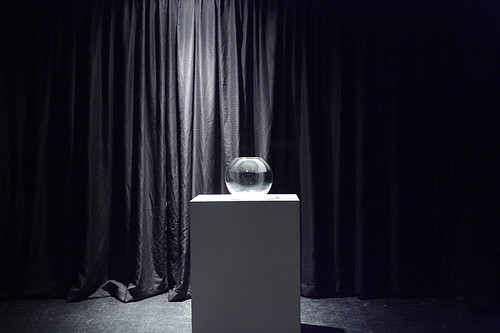
It looks like the beginning of a magic show. Black velvety curtains surround an immaculate white plinth, on top of which rests a voluminous glass fish bowl. Pancho emerges, looking a bit like a game show host: red tie, white shirt, and black pants. Some game show-type music comes on the sound system. A water bottle emerges from behind the plinth, he takes a sip.
The show begins. One after another, Coca-Cola bottles emerge from behind the plinth, are opened and emptied into the fishbowl. Empty bottles are neatly lined up in front of the plinth, labels facing forward, and bottle caps are placed on top with equal precision. Lopez is just pouring Coke into a glass bowl, but there is something hilarious about the whole debacle. As yet another bottle appears from behind the plinth, you just have to laugh. Maybe it's the samba covers of "Smooth Operator" and Prince's "Kiss" that animate the performance. Maybe it's the way in which Lopez, completely straight-faced, coyly finds yet another way to pour Coke into the vessel, now over the shoulder, now two at once.
Twenty bottles of Coke transforms the fishbowl into an enigmatic black orb with a pulsing meniscus, threatening to spill at any moment. Twenty-one sends the liquid fizzing over the glass, spilling over the edges of the plinth and onto the floor. Lopez takes a break, pointedly finishing his bottled water as he surveys the squandered bottles of Coke. The final bars of "Smooth Operator" play out. On the last beat of the song, he pulls a baseball bat out of nowhere like a rabbit from a hat and smashes it into the black globe. Glass shards and Coke spatter everywhere. In the heat of the moment, someone throws a chair, barely missing LIVE's director, Randy Gledhill. Brilliant.
- stacey ho
Anna Syczewska

A pyramid of rotten tomatoes and a motorized wheelchair greet us as a sample of music, like tortured cows over an industrial beat, loops over the sound system. The wheelchair slowly turns and we are under the indifferent gaze of Anna Syczewska. She sits on her throne in aviators, white gloves, with a bottle of wine, and cigarettes. She surveys the crowd or perhaps nothing at all. A man dressed in work clothes begins bringing out equipment: boards, bags, buckets, hardshell cases, and finally a large Y-shaped contraption that looks like it's made of steel chains. In a most friendly voice, this man informs us that there will be some welding happening during the performance. We should not stare directly at the light, and if the fumes are too much for us, he suggests that we leave the room. Syczewska lights a smoke and the 'music' is amped up, increasing in speed.
What follows is gloriously unwatchable. Syczewska's feet are lifted onto the Y-shaped sculpture so that her legs are spread above her head. She is wearing a pair of serious pumps, with soles of steel. Worker-man reveals a TIG welder. He proceeds to meticulously attach six long spikes to the bottom of each pump, a time-consuming process that eventually drives most of the audience out of the room. Meanwhile, the sound loop speeds up incrementally, from a D+B break to a dance pop beat, singing something like "LOVE DANCE, LOVE DANCE, LOVE DANCE, LOVE DANCE". The repetition is maddening, and also the sample is infuriatingly out of sync. We are all bored to tears, sick of the noise, sick from fumes, waiting for the process to be over. People leave, chat, read, nap, and text message. Syczewska is impassive. The Duchess is getting her pedicure, and she doesn't care how long it's going to take. We wait.
I go outside for some air, and someone shouts out that the last spike is being welded. Assistants quickly clear away all the welding gear and the music fades out. In the wheelchair, Sychzewska inches up to us and does a little spin. Approaching the tomatoes, she runs over a few, selects one from the top of the pile. Music fades in and thank god it's something different. Really happy, exciting music, maybe Spanish. With great effort, she begins to stand. Her legs are shaking from strain. Precariously, she runs the tomato along her thigh down to her ankle. We all expect her to somehow stomp through the pile, but no. She tries to ease herself back into the wheelchair, falls, twists her foot. The fall looks really painful.
Again donning her spiky heels, Syczewska returns to the wheelchair, backs up, and indicates to us that we should clear the way. We quickly make a passage, moving aside our chairs. Joyful music pumping through the air, Syczewska guns it down the aisle, driving her feet straight into the wall. Her shoes are embedded there, left to remain for the rest of the festival, ominous, glamourous.
- stacey ho
Day 10: Crunch time

At the end of the evening, one of Anna Syczewska’s high-heeled shoes, the ones with the 10-inch spikes welded to their soles, remained impaled in the wall. The other lay at the base of the wall where it fell, under the gouged drywall. Her electric wheelchair stood empty, its wheels covered in crushed tomato, the result of its passage over the pile of rotten tomatoes. The tech team had put away the arc-welding equipment and the homemade gynecological stirrups that had held her feet as the professional welded the spikes to the soles of her shoes.
Nothing much clears a room quite as effectively as a 45-minute session of electric arc welding in an enclosed space. The blinding light, the noxious fumes, and the bludgeoning soundtrack pushed the majority of the audience back into the bar or onto the street for some fresh air. Syczewska in her sunglasses sat impassively in her wheelchair tippling from a wine bottle waiting for the slow industrial process to finish.
By the time the spikes on both shoes had been welded in place, it was evident that she had trouble moving her legs. They had remained splayed apart, held in place in her stirrups which would have looked right at home in a clinic run by motor-heads. It was constructed out of three lengths of welded chain, which formed the “Y” and a couple of pieces of bent re-bar that held her feet.
Once the welder completed his painstaking work, the crowd re-entered the gallery space and the show entered another phase. Syczewska stood upright momentarily with the modified shoes. As she balanced precariously, she rubbed a tomato over her legs. Unable to maintain the pose, she collapsed back into the motorized chair.

She maneuvered her chair back away from the audience. Motioning with her hands, she indicated to us that she wanted a path cleared in the rows of chairs. As a way parted in front of her, she revved the chair and moving forward at speed she hit the wall. One shoe remains impaled to this day.
Moe Satt from Yangor Myanmar, presented a simple understated piece. His set consisted of a chair set before a screen. A camera captured both he and the set, and it its image on the screen behind Satt. The positioning of the camera and the video projector were such that it created an infinite repetition of images of Satt on screen, similar to the infinite series of images created by two facing mirrors. In this video version however, the images grew rather than decreasing in size and only the first couple of iterations were visible.
Satt began the show by removing his jacket and shirt. Bare-chested he adjusted the wrap covering his legs, taking care to tie it, in what I imagined to be the traditional manner. Having tied it at the waist he then gathered it up and tied it again to that it covered his genitals and buttocks leaving his legs bare.
He continued by making a number of stylized and symmetric gestures with his hands, positioning them over his eyes, on his face, or over his head. In the audience, we saw these in flesh and blood, as a black shadow projected on to the screen and in the cascading series of video images projected on the screen behind him.
Walking up to the audience he indicated that certain members should mimic him. Satt accompanied these gestures with a whistling of single tones.
At a certain moment, Satt closed the action by walking to the back of the stage, kneeling and bowing.
In analysis Freud spoke of the screen memory. This was a memory, which served to protect the ego from the effects of trauma. It accomplished this by covering the memory of the original trauma with the memory of something else, usually another anodyne event. During analysis the analysand, would return to this harmless memory and to a certain extent this screen memory would come to stand in for original difficult and painful memory.
Anne-Sophie Turion piece recounted a series of childhood memories; a car drive around a lake with the family, a the fragment of a conversation on a telephone, the music her father played on their car drives, the banal exchanges at the family supper table.
The piece began at dinner table set for a party of seven. On the wall behind the set, the Turion’s text and simple stage directions were projected onto the wall. In her halting English, Turion began by telling us that she wished to share a memory with us, but that it was difficult to find the precise memory.
This opened the way to her fragmentary, repetitive and partial description of a number of childhood memories. Interspersed with her narrative she presented the lush musical excerpts that her father enjoyed listening to in some distant past. These included the theme music from the film Jurassic Park, David Bowie, the Doors, and the Hall of the Mountain King.
We never learn of the hidden trauma, or indeed if there were such a thing. There are repeated mentions of her brother and mother but everything is banal to an extreme.
The piece climaxes with Turion climbing up onto the dinner table to lip-sing a song, one of her father’s greatest hits.
It ends as it began with the table reset for seven and Turion repeating her introductory phrases.
We are caught in a neurotic return; never capable of escape from the terrible gravities of a childhood we can never fully recognize and never escape.
FA
Subscribe to:
Posts (Atom)
